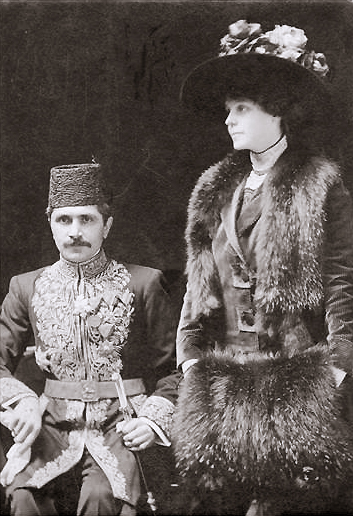
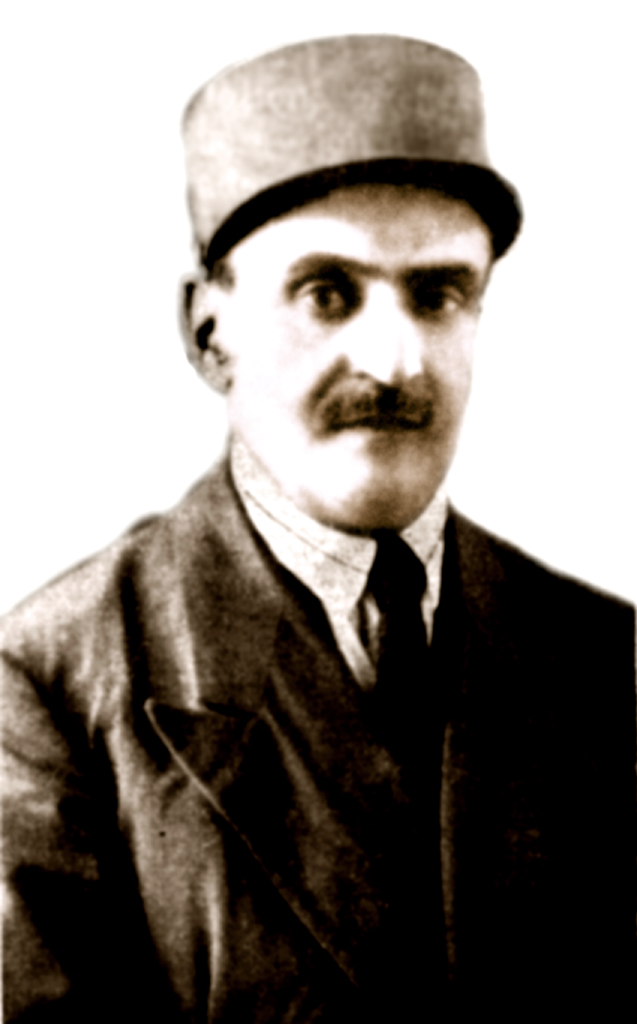
Edward and Lua Getsinger
August 8, 2013
July 25, 2013
John Eichenauer - the youngest pioneer of the Faith as of 1939
John Eichenauer, the youngest pioneer of the Faith, who in 1939, at the age of seventeen, went to San Salvador to establish a Baha'i center.
June 8, 2013
Gerda and Martin Aiff with their six children
German
Baha’is, Gerda and Martin Aiff with their six children, following their arrival
in South West Africa (today’s Namibia) in 1959.
Gerda Aiff
May 16, 2013
May Ellis Bolles
May Ellis Bolles, portrait by the well-known artist Pierre-Emile Cornillier, spring of 1900, the year after her pilgrimage to Akka and meeting ‘Abdu’l-Baha.
May Bolles after her first pilgrimage, circa 1899
April 29, 2013
April 20, 2013
March 26, 2013
March 20, 2013
March 10, 2013
Enoch Olinga, Ali Nakhjavani and some early pioneers in Cameroon
Early pioneers in Cameroon. Sitting left to right: Enoch
Olinga, Ali Nakhjavani. Standing: Samuel Najiki, David Taonti, Benedict Ebala.
February 25, 2013
Hands of the Cause: Dorothy Baker, Shu’a’u’llah Ala’i, Ali-Akbar Furutan, Tarazu’llah Samandari, Musa Banani, and Valiyu’llah Varqa
Some of the Hands of the Cause attending the Stockholm
Conference, 1953. From left to right: Dorothy Baker, Shu’a’u’llah Ala’i, Ali-Akbar
Furutan, Tarazu’llah Samandari, Musa Banani, and Valiyu’llah Varqa
February 8, 2013
Haji Mirza Haydar-Ali -- 'the Angel of Mount Carmel'
Haji Mirza Haydar-Ali
Born into a -Shaykhi family of Isfahan, Haydar-'Ali was for a time a disciple of Karim Khan, the Shaykhi opponent of the Báb. But after studying the Bab's Writings and seeing the behaviour of the martyrs, Haydar-'Ali became a Bábi. When Baha’u’llah declared Himself to be the Promised One, Haydar-'Ali accepted Him and met Baha'u'llah in Adrianople. He was sent to Egypt where the Persian consul had him arrested. At the end of ten years' imprisonment in the Sudan, he was sent by Baha'u'llah to Persia and Iraq where he spent some twenty-five years travelling throughout the land, encouraging and inspiring the Persian Baha'is. After the passing of Baha'u'llah, Haydar-'Ali devoted himself to 'Abdu'l-Baha and was a staunch defender of the Covenant. He spent his last years in Haifa where he became known as 'the Angel of Mount Carmel' and wrote his memoirs, The Delight of Hearts. He died in 1920 and is buried in the Baha'i cemetery at the foot of Mount Carmel. (A Basic Baha’i Dictionary, by Wendi Momen)
January 14, 2013
December 22, 2012
December 6, 2012
Dr. Peter Jamel Khan - a "distinguished servant"
Dr. Peter Jamel Khan
With the passing
of Dr. Peter J. Khan, the worldwide Baha'i community has lost a
"distinguished servant."
"By any
measure, his was a remarkable life, one of earnest striving, of unbending
resolve, of unflinching dedication to principle, and of constancy of
effort," wrote the Universal House of Justice, on learning of Dr. Khan's
sudden passing on 15 July.
Dr. Khan – who
was 74 years old when he died – was a member of the Universal House of Justice
for 23 years, until his return to Australia in May last year.
Peter Jamel Khan
was born in New South Wales on 12 November 1936 to Fazal and Hukoomat Khan from
Khassi Kalan in the Punjab region of India. Four years before their son's
birth, they were among the first Indian immigrants to settle on Australia's
eastern coast.
November 18, 2012
October 16, 2012
Philip Hainsworth -- one of the first Baha'is in Uganda
Philip Hainsworth, one of the first Baha'is in Uganda, with his wife Lois in front of the House of Worship in Kampala at the 50th Year Anniversary festivities, August 2001.
Phlip and Lois Hainsworth with their son, Richard, at the top of the Bahá’í House of Worship
in Kampala, Uganda, shorthly before it was completed in 1961. Mr. Hainsworth
was one of the six Baha’is who founded the Bahá’í community in Uganda in 1951.
(Baha’i Media Bank)
September 11, 2012
Nabil-i-Akbar -- An Apostle of Baha'u'llah and a Hand of the Cause
Aqa Muhammad-i-Qa'ini, surnamed Nabil-i-Akbar
Muhammad-i-Qa'ini, was surnamed Nabil-i-Akbar by Baha’u’llah.
He was also known as Fadil-i-Qa'ini (the Learned One of Qa'in). He was arrested
as a Bábi, a charge which he denied, however that incident started him thinking.
He studied the Writings of the Báb and became a believer. Later, he became an
eminent mujtahid and met Baha'u'llah in Baghdad, before He had declared His
Mission. At first he did not recognize Baha'u'llah's station, but after
listening to a discourse of Baha'u'llah, he became a Baha'i. He taught the
Faith widely and was arrested three times. It was to Nabil-i-Akbar that
Baha'u'llah's Tablet of Wisdom (Lawh-i-Hikmat) was addressed. He died in
Bukhara, Russia, in 1892. 'Abdu’l-Baha designated him a Hand of the Cause and
Shoghi Effendi included him among the Apostles of Baha'u’llah.
(Adapted from ‘A Basic Baha’i Dictionary’, by Wendi Momen)
August 25, 2012
August 11, 2012
Mishkin-Qalam -- an Apostle of Baha'u'llah
Aqa Husayn-i-Isfahani, distinguished calligraphist, and companion-in-exile of Baha’u’llah, surnamed “Mishkin-Qalam”: “Musk-scented pen”, a name by which he as a calligrapher of the first rank was known. He first heard of the Faith in Isfahan, but it was in Baghdad that he learned more about it. In Adrianople he met Baha'u'llah and became His follower. When Baha'u'llah and His companions were exiled to 'Akka, Mishkin-Qalam was sent to Cyprus. He was eventually freed and came to the Holy Land in 1886. After travelling in Egypt, Damascus and India, 'Abdu'l-Baha asked him to come back to the Holy Land, where he passed away in about 1912.
It is Mishkin-Qalam's calligraphic rendering of the Greatest Name which Baha'is most commonly use as its symbol.
(Adapted from 'A Basic Baha’i Dictionary', by Wendi Momen)
August 3, 2012
Albert Windust -- First publisher of the Writings of the Faith in the West
Albert Robert Windust (1874-1956)
An early Chicago Baha'i and publisher. He became a Baha'i in
1897 and was a member of the first Spiritual Assembly of Chicago. He became the
first publisher of Baha'i literature in the West, including the Hidden Words.
In 1910 he founded and printed the Baha'i magazine Star of the West and later
collected and published three volumes of 'Abdu'l-Baha's Tablets to American
believers. He also helped Howard MacNutt to publish The Promulgation of
Universal Peace.
July 25, 2012
Alfred Lunt
Prominent Boston Baha’i lawyer who became a Baha’i shortly after hearing a lecture by Ali Kuli Khan in the winter of 1905. He was engaged by Sarah Farmer as her lawyer in her struggle to keep Green Acre in the hands of the Baha’is. He was a member of the Executive Board of the Baha’i Temple Unity and later of the National Spiritual Assembly of the United States.
July 15, 2012
Nabil-i-A'zam -- An Apostle of Baha'u'llah and the author of Dawn-Breakers
Muhammad-i-Zarandi, surnamed Nabil-i-A'zam
Amatu’l-Bahá Rúhíyyih Khánum describes The Dawn -Breakers, Nabíl’s chronicle, as ‘a classic among epic narratives in the English tongue’ (PP 215). The author was Muhammad Zarandí, who wrote his narrative in Persian. Bahá’u’lláh gave him the title of ‘Nabíl-i-A‘zam’, which means ‘the most great Nabíl’. Nabíl, in both Persian and Arabic, means ‘noble’, or ‘excellent’, and according to the Abjad reckoning, the two words Muhammad and Nabíl have equivalent numerical values. Zarand is a town in one of the outlying districts of Tehran. Nabíl was on a visit in a nearby locality in Rubat-Karim when he heard for the first time that a merchant in Shiraz had declared Himself as the Promised One of Islam. He soon pursued his interest in the new Faith by contacting those who were among the most prominent believers of the Báb, and became a Bábí around the year 1847. During that period he met Bahá’u’lláh twice, once in Kirmánsháh, and once in Tehran.
July 8, 2012
Dr. Stanwood Cobb
Dr. Stanwood Cobb presenting a talk in Atlanta, Georgia, shortly before his passing in 1982 at the age of 101. (Baha'i News, March 1989)
To review Dr. Cobb's life is to make a beautiful and heavenly journey through those marvelous years beginning with the early dawn of the Bahá'í Faith in the United States when news of this 'new Revelation' and of the presence of 'Abdu'l-Bahá in the Holy Land reached the ears of a few 'ready souls', aroused their curiosity, quickened their hearts and resulted in their making their way to 'Akká in an ever-increasing stream to enter the Master's presence.
An account of Dr. Cobb's introduction to the Bahá'í Faith in 1906 is given in his Memories of 'Abdu'l-Bahá and in Star of the West, Vol. 15, No. 1, April 1924. He was at that time studying for the Unitarian ministry at the Harvard Divinity School but was drawn to Green Acre in Maine as a result of a series of weekly articles in the Boston Transcript. Miss Sarah Farmer introduced Dr. Cobb to the singer, Mary Lucas, who had just returned from visiting 'Abdu'l-Bahá. '… within half an hour from that moment I became a confirmed Bahá'í and have remained so ever since,' Dr. Cobb wrote.
June 28, 2012
Dorothy Baker -- Hand of the Cause
Dorothy Baker and family
Dorothy Baker with daughter Louise Baker Matthias
Born in Newark, New Jersey, 21 December 1898, Dorothy was the granddaughter of Mother Beecher, herself a Baha'i, who took her to see 'Abdu'l-Baha in New York in 1912. Dorothy was too shy to speak during that meeting, although she wrote afterward to Him stating that she wished to serve the Cause. 'Abdu'l-Baha responded that He would pray that God would grant her desire. She developed into a most eloquent, persuasive, and convincing teacher for small groups or large audiences, and in addition to an inimitable charm she had a sincerity that was with her always -- she was an ardent Baha'i first, last, and at all times.
June 20, 2012
Dr. Arastu Hakim
Dr. Arastu Hakim
Dr. Arastu Khan Hakim belonged to the third generation of Baha'is. His grandfather, Hakim Masih was court doctor to Muhammad Shah and the first Jewish Baha’i. Hakim Masih's life takes us back to the very early history of the Cause for he had learned something of the new faith when he was in Bagdad through Tahirih herself, during the early days of the Bab's manifestation. From that time on he had searched for the source of her power. Later in Tihran, when Moslem doctors refused, he had offered to visit the prison and treat a Baha'i child. The father of the child was the famous Ismu'llahu'l-Asdaq and in the course of these visits Hakim Hakim Masih became a Baha'i and later achieved much fame in the Cause.
June 13, 2012
Vaeino Rissanen -- the first in Finland to become a Baha'i
He was the first in Finland to become a Baha'i in 1938 by Josephine Kruka, the "Mother of Finland".
(The Baha'i World 1976-1979; Paragraph 171.3 footnotes of Messages from the Universal House of Justice, 1963-1986)
May 24, 2012
Leonora Holsapple Armstrong -- “mother of the Bahá'ís of Brazil”
Leonora Holsapple Armstrong --“mother of the Bahá'ís of Brazil”
(The Universal House of
Justice, message dated January 1977; ‘Messages from the Universal House of
Justice 1963-1986’)
May 10, 2012
Marion Jack -- an "immortal heroine", a "shining example to present and future generations"
Marion Jack (1866-1954)
Her courageous exploits in service to the Baha'i Faith inspired Shoghi Effendi to describe her as an "immortal heroine" and a "shining example to present and future generations." (The Baha'i World 1976-1979)
Marion Elizabeth Jack, circa 1885
Born in 1866, into a prominent family in St. John, New
Brunswick, Canada, Marion Jack attended school in London and Paris, where she
encountered and immediately embraced the Baha'i Faith. From that day forward
she was a pioneer; one who breaks new ground, one who paves the way for those
who are to follow.
She spent some time in the Holy Land, and while there taught
English to 'Abdu'l-Baha's grandchildren. In 1914 she returned to Canada and was
among the first to respond to the call of the Divine Plan, pioneering to
Alaska, and teaching in Toronto, Montreal, and elsewhere.
May 5, 2012
Rufino Gualavisi
Rufino Gualavisi
Rufino Gualavisi Farinango, a renowned indigenous Baha’i teacher, died March 23, 1990 in Otavalo, Ecuador. Mr. Gualavisi taught the Faith to thousands of indigenous people and campesinos and helped open many difficult areas of the country [Ecuador] to the Faith, often accompanied by his spiritual father and teaching companion, Counsellor Raul Pavon. Although beaten and imprisoned at various times, he remained steadfast and never once wavered in his teaching efforts. He is buried in the cemetery "Parques del Recuerdo" in Quito, on the left side and adjoining the resting place of his good friend and staunch admirer, the Hand of the Cause of God Rahmatu'llah Muhajir. On learning of Mr. Gualavisi's passing, the Universal House of Justice cabled the National Spiritual Assembly of Ecuador: "Deeply saddened news passing outstanding sacrificial teacher Cause God Rufino Gualavisi. His noble qualities, his loving nature, his immense services indigenous masses native land never to be forgotten and worthy source pride your community. Urge hold befitting memorial meetings his blessed memory throughout country. Assure fervent prayers Holy Threshold for progress his radiant soul Kingdom on high. Kindly extend heartfelt condolences family and friends." (Baha’i News, June 1990)
Subscribe to:
Posts (Atom)